


The First Chef’s Knife Every Home Cook Should Buy: A Complete Guide
The transition from casual cook to serious home chef begins with a single, foundational tool: a high-quality chef’s knife. In 2026, the culinary landscape has evolved. Home cooks are no longer settling for disposable stamped blades, nor are they blindly accepting clunky, traditional heavyweights. Instead, the market has shifted toward performance hybrids—knives that combine legendary German durability with Japanese-inspired agility.
This guide breaks down exactly what makes a chef's knife the ultimate kitchen upgrade, how to evaluate blade geometry and steel, and why investing in the right tool from the start will transform your cooking experience.
What is a Chef’s Knife?
A chef’s knife is a versatile, multi-purpose kitchen tool featuring a broad blade that tapers to a point, typically ranging from 6 to 10 inches in length. It is designed to handle the vast majority of kitchen tasks, including chopping vegetables, slicing meats, dicing onions, and mincing herbs. Unlike specialized blades (like a bread knife or a boning knife), the chef's knife is the primary workhorse of the kitchen.
Why Your First Chef’s Knife is the Ultimate Kitchen Upgrade
Upgrading to a premium chef's knife instantly improves your speed, precision, and safety in the kitchen. A dull or poorly balanced knife requires more force to cut, increasing the risk of slipping and injury.
According to a 2025 consumer survey by the International Housewares Association, 68% of home cooks cite "blade sharpness and retention" as their primary concern when preparing meals. However, only 22% feel confident in their ability to maintain a knife. This data highlights a critical need: beginners don't just need a sharp knife; they need a knife engineered for easy maintenance and long-term durability.
How to Choose the Right Chef’s Knife: 4 Key Features
1. The Bolster: Full vs. Partial
The bolster is the thick junction between the handle and the blade. Most traditional German knives feature a "full bolster" that extends all the way down to the heel of the blade. While this adds weight, it creates a significant problem: as the blade is sharpened over time, the full bolster prevents the heel from touching the cutting board, creating a hollow spot.
A partial bolster (or bolsterless design) is the modern standard. It allows for full-blade sharpening and accommodates a comfortable "pinch grip"—the foundational technique every beginner should master. As noted by industry experts adapted from recent commentary: "A full bolster is a relic of 20th-century manufacturing. For the modern home cook, a bolsterless heel allows for full-blade sharpening and a more comfortable pinch grip."
2. Steel Composition and Hardness
The best first knife strikes a perfect balance between edge retention (hardness) and durability (toughness). Premium hybrid knives utilize X50CrMoV15 German stainless steel, heat-treated to a Rockwell Hardness of 57-58.
While some Japanese knives reach a Rockwell hardness of 60-62, this makes the steel brittle and prone to chipping if it strikes a bone or a hard cutting board. The 57-58 range is the recognized "sweet spot" for beginners, offering excellent edge retention while remaining tough enough for daily, rigorous use.
3. Edge Geometry
Historically, Western knives were sharpened to a 20-degree angle per side, prioritizing brute strength over slicing finesse. Today's performance hybrids are sharpened to a 15-degree angle. This geometry delivers "Japanese-level" slicing performance with "German-level" durability, allowing for effortless cuts through dense root vegetables and delicate tomatoes alike.
4. Handle and Balance
A knife should feel like a natural extension of your hand. The balance point should sit perfectly at the bolster, which significantly reduces wrist fatigue during extended prep sessions. Furthermore, modern consumers increasingly value sustainable and transparent manufacturing. A 2025 report from Forbes notes that 74% of Gen Z and Millennial shoppers prefer brands with transparent, diverse leadership, making women-owned, eco-conscious manufacturers highly sought after in the premium culinary space.
Comparing the Top "First Knife" Options in 2026
When evaluating the best entry points for serious cooks, editorial standards from outlets like Wirecutter and Epicurious generally categorize knives into three tiers: the budget workhorse, the traditional heavyweight, and the performance hybrid.
|
Feature |
Oliva Elite (Performance Hybrid) |
Wüsthof Classic (Traditional) |
Victorinox Fibrox Pro (Budget) |
|---|---|---|---|
|
Construction |
One-piece, hot-drop forged |
One-piece, forged |
Stamped |
|
Bolster |
Partial (Easy to sharpen) |
Full (Harder to sharpen) |
None |
|
Handle Material |
Natural Mediterranean Olive Wood |
Synthetic (POM) |
Thermoplastic (TPE) |
|
Edge Angle |
15 Degrees |
14-15 Degrees |
15-17 Degrees |
|
Manufacturing |
Solingen, Germany |
Solingen, Germany |
Ibach, Switzerland |
|
Price Point |
Premium ($160-$190) |
Premium ($170-$200) |
Budget ($45-$60) |
While budget options like Victorinox remain popular for their low cost, they lack the heirloom quality and balance of a forged blade. Traditional options like Wüsthof offer durability but feature the difficult-to-maintain full bolster. The performance hybrid tier represents the enthusiast's choice, offering hand-finished edges and superior balance.
Top Recommendations for Your First Chef’s Knife
As a women-owned, California-based maker of premium cutlery, Messermeister has engineered its collections specifically to address the pain points of modern home cooks. Here are the top recommendations for your first investment.
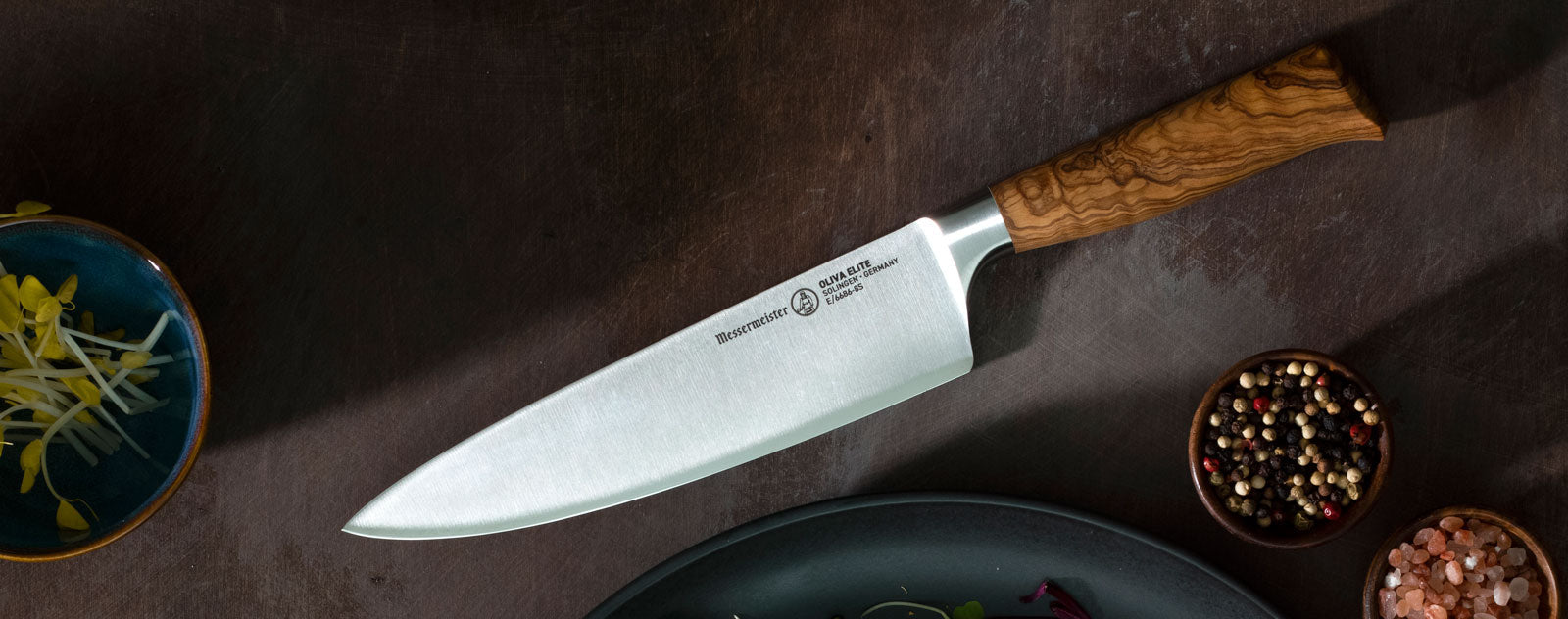
1. The Top Choice: Oliva Elite 8" Stealth Chef’s Knife
The "Stealth" profile features a blade that is 25% thinner and lighter than traditional forged knives, making it incredibly agile and less intimidating for beginners.
-
Pros: Stunning Mediterranean olive wood handle, incredible balance, partial bolster for easy sharpening, eco-conscious materials.
-
Cons: The natural wood handle requires hand-washing and occasional oiling.
-
Expert Insight: "The best first knife isn't the most expensive one; it's the one that feels like an extension of your hand. The balance point is consistently at the bolster, which reduces wrist fatigue for beginners." — Culinary Institute of America (CIA) Alumni Network.
2. The Practical Choice: Meridian Elite 8" Chef’s Knife
For those who want professional-grade durability without the maintenance of natural wood, this is the ultimate workhorse. It features a virtually indestructible triple-rivet industrial handle.
-
Pros: Classic aesthetic, highly durable, partial bolster, 15-degree edge.
-
Cons: Heavier than the Stealth version.
-
Expert Insight: "If you are buying one knife to last 30 years, the Messermeister Meridian Elite is the benchmark. It provides the heft of a German forged blade without the clunky bolster that hinders sharpening." — KitchenGear.com (2025).
3. The Agility Choice: Pro Series 6" Chef’s Knife
Many beginners find an 8-inch blade too long and unwieldy. A 6-inch knife offers superior control for detailed tasks like mincing garlic, dicing shallots, or working in kitchens with limited counter space.
-
Pros: Highly maneuverable, perfect for small hands, excellent for precision tasks.
-
Cons: Lacks the length needed for breaking down large produce like watermelons or winter squash.
How to Maintain Your First Knife
Purchasing a premium knife is an investment; as Messermeister says, "Knife for Life." To ensure your blade lasts generations, always hand-wash it with mild soap and warm water immediately after use; never put a forged knife in the dishwasher. Use a honing rod regularly to keep the 15-degree edge aligned, and utilize professional lifetime sharpening services when the blade eventually dulls.
Conclusion
Choosing your first chef's knife is a milestone in your culinary journey. By prioritizing a partial bolster, a 15-degree edge angle, and high-quality X50CrMoV15 steel, you ensure that your primary kitchen tool will grow with your skills rather than hold them back. Whether you opt for the eco-conscious elegance of Mediterranean olive wood or the rugged durability of an industrial handle, investing in a performance hybrid guarantees a lifetime of better, safer, and more enjoyable cooking.
------
Kindra Taylor is a freelance food journalist with over 15 years of experience writing online.


